The foundation of the Camo Tech Pac is Veto Pro Pac's patented center‑panel design. Unlike a conventional backpack, which typically has a single large compartment divided by internal pockets, the Tech Pac is built around a rigid central panel that creates two distinct storage bays. Each bay contains two tool storage platforms—flat panels covered with pockets and sleeves—that face inward toward the center panel. This arrangement means that the tools are stored on both sides of the bag, with the weight distributed symmetrically around the wearer's spine. When the backpack is opened, the tools on the front platform and the tools on the rear platform are both visible and accessible, without having to dig through layers of pockets or move one set of tools to reach another. The center panel itself provides structural rigidity, preventing the backpack from collapsing into a shapeless lump when it is partially empty. It also contributes to the bag's ability to stand upright on its waterproof, injection‑molded polypropylene base—a feature that is far more important than it sounds. An HVAC technician working on a rooftop or in a mechanical room often needs to set the backpack down on a surface that is wet, muddy, or covered in debris. A backpack that falls over dumps its contents, soaks its fabric, and forces the technician to waste time repacking. A backpack that stands upright, with its base keeping the fabric off the wet surface, keeps the tools dry, accessible, and organized. The base is thick, rigid, and shaped to resist tipping, and it is one of the features that Veto Pro Pac users consistently cite as a reason for their loyalty.
The Camo Tech Pac offers more than 50 pockets, distributed across the interior and exterior of the bag. This is not a case of adding pockets for the sake of a high number on a specification sheet. The pockets are sized and shaped for specific tools and instruments. The vertical pockets on the front panel are taller in this iteration than on previous models, accommodating longer tools such as screwdrivers, nut drivers, and pry bars. The pockets are sewn from a light gray fabric—a deliberate choice that improves visibility inside the bag, making it easier to see the tool you are looking for against the bright background. The exterior of the bag includes a variety of storage options: D‑rings for attaching carabiners or tethering tools, a magnetic screw catcher on the front mesh pocket that holds small ferrous fasteners and bits, a compact stainless steel tape measure clip that keeps a tape measure conveniently accessible without taking up pocket space, and a dedicated manifold gauge and hose storage pocket that accommodates the bulky, awkwardly shaped equipment that is essential to HVAC service work. The manifold gauge pocket is one of the features that distinguishes the Tech Pac from a general‑purpose tool backpack. Gauges and hoses are large, heavy, and difficult to store neatly. The Tech Pac provides a designated, padded pocket that holds them securely, protecting both the equipment and the other tools in the bag from damage. The rear storage bay is accessed via a quick‑release metal hasp that allows the technician to open the bay quickly, without fumbling with zippers, and that provides a positive load connection for the shoulder straps when the bag is closed. The hasp is made from metal—not plastic—and it is designed to withstand repeated use without breaking or loosening.
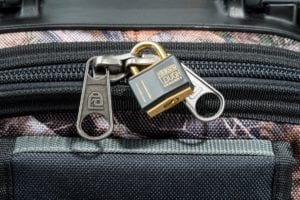
The materials and construction of the Camo Tech Pac are what set Veto Pro Pac apart from the competition. The body fabric is a PVC‑impregnated denier nylon, in weights of 950 and 1250 denier, which is significantly heavier and more abrasion‑resistant than the 1680‑denier ballistic nylon that most premium tool backpacks use. PVC impregnation means that the nylon fibers are coated and saturated with polyvinyl chloride, creating a material that is not merely water‑resistant but weatherproof—water will not soak through the fabric, even under pressure. The tool pocket fabric is an even heavier 1800‑denier PVC‑impregnated nylon in light gray, chosen for its durability and its visibility. The stitching is industrial‑strength double nylon stitching, with reinforcing at all stress points. The zippers are heavy‑duty plastic coil zippers with oversized tabs, double‑stitched into the fabric. The D‑rings are powder‑coated steel, not the plated pot metal that can crack under load, and the rivets are marine‑grade—designed to resist corrosion in saltwater environments. The shoulder straps are padded with an EVA thermoformed foam that conforms to the wearer's body, and they incorporate multiple adjustment points to achieve a custom fit. The sternum strap and the waist belt help to distribute the load and prevent the backpack from shifting during movement. The TPV rubber carry handle is ergonomically shaped and comfortable in the hand, and it is reinforced to support the full weight of the loaded bag. The shoulder strap buckles are metal, not plastic, because plastic buckles are a known failure point on heavily loaded backpacks. The tape measure clip is also metal, attached to the exterior of the bag with rivets, and it will not snap off when snagged on a ladder rung or a door frame. The quick‑release metal hasp, the metal strap buckles, and the metal D‑rings are all powder‑coated to resist corrosion. The aluminum hang hook is stored internally, then deployed when needed to suspend the backpack from a ladder, a scaffold, or a pipe. Veto Pro Pac publishes load test data for the Camo Tech Pac—a remarkable level of transparency in an industry where most manufacturers simply claim "heavy‑duty construction" without quantifying what that means. The bag was pulled to destruction at 830 pounds before the handle failed; the hook failed at 200 pounds. These are not forces that a backpack would experience in normal use, but they demonstrate the margin of safety built into the design. A technician who loads the bag with 40 or 50 pounds of tools—a realistic figure for a fully equipped HVAC service backpack—can do so with confidence that the straps, the handle, and the hook will not fail.
What the Camo Tech Pac Is Not
The Camo Tech Pac is not a backpack for the casual user, the weekend DIYer, or the professional who carries only a handful of tools. Its size, weight, and price place it firmly in the category of professional‑grade equipment, aimed at the technician who carries a comprehensive set of tools, instruments, and accessories to every job, and who expects those tools to be organized, protected, and accessible. At 9 pounds empty, the Tech Pac is heavy even before a single tool is placed inside. A fully loaded Tech Pac can easily weigh 40 or 50 pounds, which is a significant load to carry on the back, up ladders, and through mechanical rooms. The padded shoulder straps, the sternum strap, and the waist belt help to distribute that weight and make it manageable, but the user must be realistic about how much they are carrying. The center‑panel design, which contributes so much to the bag's organization and stability, also means that the backpack does not collapse flat when empty. It retains its shape and its bulk, which can be a consideration when storing the bag in a truck or a crowded closet. The camouflage pattern, while distinctive and attractive, may not be to everyone's taste, and it may not be appropriate in all professional settings—though the Kanati pattern is subtle enough that it reads more as a textured dark fabric than as a traditional hunting camouflage. The Camo Tech Pac is a specialized tool for a specialized user. It is not the right backpack for someone who needs to carry a laptop more often than they carry manifold gauges. It is not the right backpack for someone who prioritizes light weight above all else. But for the HVAC technician, the industrial electrician, or the service professional who has been frustrated by backpacks that wear out, tip over, or fail to organize their tools properly, the Camo Tech Pac is not merely a good backpack. It is the backpack that they will still be using a decade from now, its camouflage pattern faded by the sun, its pockets shaped to the tools they carry, its straps molded to the contours of their shoulders. That is the Veto Pro Pac promise, and it is a promise that the Camo Tech Pac, by every indication, is built to keep.
Veto Pro Pac Camo Tech Pac Specifications
| Specification | Detail |
|---|---|
| Width | 9.875 inches |
| Length | 14.25 inches |
| Height | 21.5 inches (18.125″ with handle folded down) |
| Weight (Empty) | 9 lbs |
| Total Pockets | 56 interior and exterior |
| Storage Bays | 2 bays, 4 storage platforms |
| Base | 3mm injection‑molded polypropylene (waterproof) |
| Body Fabric | 950/1250 PVC‑impregnated denier nylon |
| Pocket Fabric | 1800 PVC‑impregnated denier nylon (light gray) |
| D‑Rings | 4 large, 5 small, powder‑coated steel |
| Zippers | Double‑stitched, heavy‑duty plastic coil, YKK locking |
| Warranty | 5 years |
| Price | ~$299 |
Conclusion: The Last HVAC Backpack You Will Ever Need to Buy
The Veto Pro Pac Camo Tech Pac is not a purchase; it is a commitment. A commitment to carrying a well‑organized, fully equipped set of tools to every job. A commitment to protecting those tools from the weather, the drops, and the wear of daily use. A commitment to a backpack that will outlast the technician who carries it, that will accumulate the scuffs and the stains of a career, and that will still be standing upright, its zippers functioning smoothly, its pockets holding their shape, long after the price paid for it has faded from memory. It is a backpack designed by a founder who spent weeks observing HVAC technicians on the job, who understood their frustrations, and who built a product that addressed those frustrations one by one. For the professional who is ready to stop buying disposable backpacks and to invest in a tool transport system that will serve them for a decade or more, the Camo Tech Pac is the benchmark against which all other tool backpacks are measured.
Comments 0
Leave a Comment